
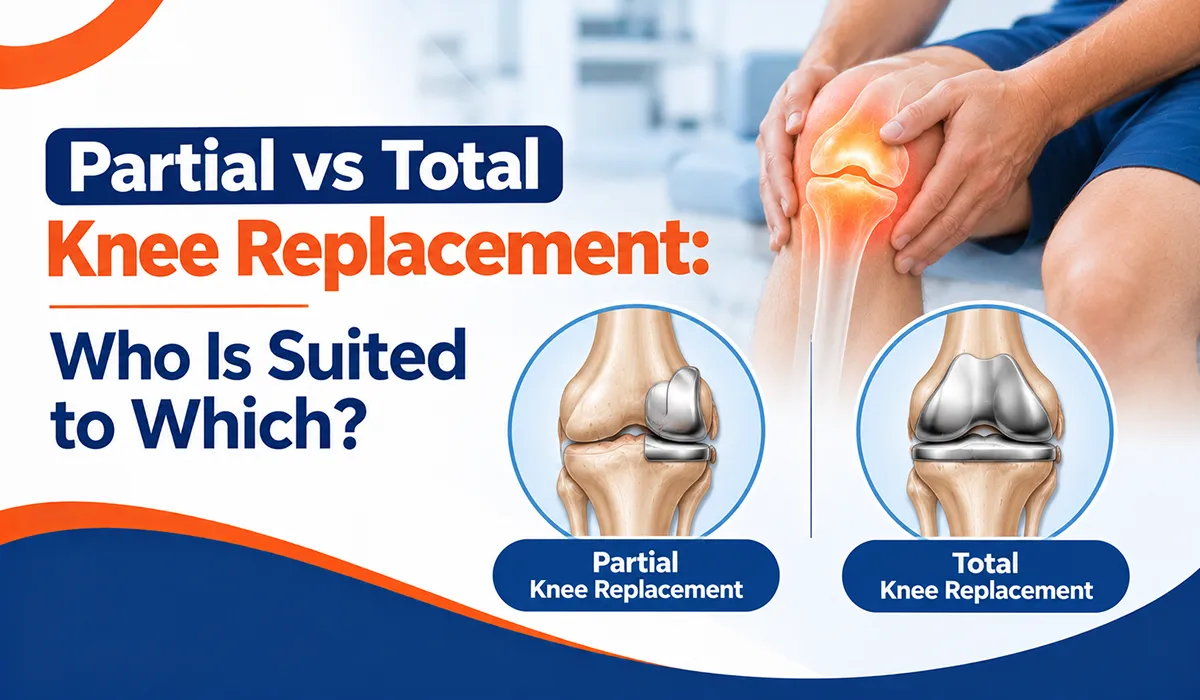
A partial knee replacement fixes only the worn part of the knee and keeps the rest of your own joint and ligaments. A total knee replacement resurfaces the whole joint. Partial suits people whose arthritis is limited to one side of the knee, with strong ligaments and a nearly straight leg. Total suits arthritis that has spread across the knee, a bent or bowed knee, or an unstable joint.
If your doctor has said you may need a knee replacement, the next question is often “Can I get a smaller surgery?” It is a fair question. Partial replacement sounds gentler, and for the right knee it can be an excellent choice.
But it is not for everyone. This guide explains how the two operations differ, who suits which, and how your surgeon decides.
If you are not yet sure you need surgery at all, start with knee arthritis grades 1 to 4 and what each stage means and our guide on whether knee replacement is the only solution for knee arthritis.
The knee has three parts
To understand the choice, picture your knee as three compartments:
- The inner side (medial). This is where most Indian knees wear first, especially in people with bow legs.
- The outer side (lateral). This wears less often.
- The front, behind the kneecap (patellofemoral). This part can wear on its own or along with the others.
In many people, arthritis starts in one compartment and stays there for years. In others, it spreads to two or three. The pattern of wear is the main reason one person suits a partial replacement and another does not.
What is a partial knee replacement?
In a partial knee replacement, also called a unicompartmental or “half” knee replacement, the surgeon replaces only the damaged compartment with a metal and plastic implant. Your healthy cartilage, bone and the important ligaments inside the knee, including the ACL, stay in place.
Because less is removed, the cut is usually smaller, and many people find the knee feels more natural afterwards.
What is a total knee replacement?
In a total knee replacement, the worn surfaces of the thigh bone and shin bone are replaced with metal parts, with a medical-grade plastic spacer between them. The kneecap surface may also be resurfaced. It treats the whole joint, so it works even when arthritis has spread everywhere.
Most people stand and walk with a walker the day after surgery and stay in hospital for 2 to 4 days. Modern implants commonly last 15 to 20 years or more.
Partial vs total knee replacement at a glance
| Partial knee replacement | Total knee replacement | |
|---|---|---|
| What is replaced | Only the worn compartment | The whole joint surface |
| Arthritis pattern | Limited to one side | Spread across the knee |
| Ligaments | Kept, including the ACL | ACL is removed |
| Leg shape | Nearly straight, or deformity that can be corrected | Any shape, including severe bow legs |
| Incision and bone cut | Smaller | Larger |
| Early recovery | Often quicker | Steady, with a clear recovery plan |
| Feel of the knee | Often more natural | Very good, but different from a natural knee |
| Long-term risk of a second surgery | Higher | Lower |
| Works for rheumatoid arthritis | Usually not | Yes |
Who is suited to a partial knee replacement?
You may be a candidate if most of these are true:
- X-rays show wear mostly on one side of the knee, usually the inner side
- The ACL, the main ligament inside the knee, is healthy
- Your knee still bends well and straightens almost fully
- Any bow leg shape is mild and can be corrected
- The pain is clearly in one area of the knee, not all over
- Your arthritis is the wear-and-tear type, not an inflammatory type such as rheumatoid arthritis
Older rules about age and weight have relaxed. Today the shape of the wear and the strength of the ligaments matter more than your age.
Who is suited to a total knee replacement?
Total replacement is usually the better choice when:
- Arthritis has spread to two or three compartments
- The knee is stiff and cannot straighten fully
- The knee is badly bowed or knocked, which is common in advanced Grade 4 arthritis
- The ACL is torn or weak, so the knee is unstable. Read more about ACL tears and their symptoms
- You have rheumatoid arthritis or another inflammatory joint disease
- Pain is all around the knee and at rest
If you fall in this group, a partial replacement may give a good result for a few years and then fail as the rest of the knee wears. A total replacement treats the whole joint in one operation.
The honest trade-off
Partial replacement has real advantages: smaller surgery, quicker early recovery and often a more natural feel. Large studies of knee replacement patients, including one published in The Lancet in 2014, found that partial replacement carried a lower risk of serious complications after surgery.
The same studies show the other side. Partial knee replacements are more likely to need a second operation over time. This often happens because arthritis spreads to a part of the knee that was left alone. A total replacement is more durable for most patients, which is why surgeons are careful about who they offer a partial replacement.
In simple words: partial can be the smarter choice for the right knee, and the wrong choice for a knee that does not fit.
How your surgeon decides
The decision is made on your knee, not on a rule of thumb. At your consultation, the doctor will:
- Ask where it hurts. You are asked to point to the painful spot. Pain on the inner side only is a good sign for partial replacement.
- Examine the knee. Movement, straightening, leg shape and ligament strength are checked.
- Order a standing X-ray. This shows the true gap between the bones. A stress X-ray or MRI is added when the surgeon needs to check ligaments or cartilage.
- Explain the options. You are told which operation suits your knee and why.
Sometimes the final decision is confirmed during surgery, when the surgeon can see the cartilage directly. A good surgeon tells you this beforehand, so you know that a switch to total replacement is possible.
At OrthoD Hospital, Dr. Ruchir Patel explains your options in simple words, along with the expected cost and recovery time, before you decide. Some surgeons also use computer or robotic assistance to place knee implants more precisely. We explain whether it makes sense for your knee during the consultation.
Recovery: what to expect
Both operations need physiotherapy, and both need you to do the exercises yourself. In general:
- Partial replacement: Many people walk the same day or the day after, and early recovery is often faster because less tissue is disturbed.
- Total replacement: You walk with support from day one. Most people return to daily activities between 6 and 12 weeks, and strength keeps improving for several months.
For a week-by-week picture, see the recovery timeline on our total knee replacement page.
If sitting on the floor matters to you, read how one patient regained cross-legged sitting after knee replacement. Tell your surgeon about this need before surgery, because it can affect the choice and the plan.
What if the first surgery needs to be redone?
Any knee implant can wear or loosen over many years. When that happens, a second operation called revision joint replacement can fix it. Our blog explains the indications for revision joint replacement surgeries. Choosing the right first operation lowers the chance that you will need one.
Do you need either surgery yet?
Not always. In early arthritis, weight control, physiotherapy and selected injections can keep you active for years. Surgery is worth discussing when pain keeps limiting your walking, sleep or work despite treatment.
If you have heard of other procedures and are unsure whether they repair or replace the joint, read our post on microplasty and whether it repairs or replaces the knee. If your knees are bowed, you may also hear about deformity correction.
When you are ready to compare surgeons, our guide on what to look for in a knee replacement surgeon in Ahmedabad can help.
Questions to ask your surgeon
Take this short list to your consultation:
- Which parts of my knee are worn, and which are healthy?
- Am I a candidate for a partial replacement, and why or why not?
- What is the chance you will switch to a total replacement during surgery?
- How long will my implant last, and what happens if it wears out?
- What will my recovery look like week by week?
- What is the total expected cost, including physiotherapy?
Frequently asked questions
Is partial knee replacement better than total knee replacement?
Not better for everyone. It is better for the right knee, where arthritis is limited to one side and the ligaments are strong. For arthritis that has spread, total replacement is the more reliable and durable operation.
How do I know if I am a candidate for partial knee replacement?
A doctor needs to examine your knee and look at a standing X-ray. The key signs are wear on only one side, a healthy ACL, good movement and a mild leg deformity. Only an examination can confirm it.
Does partial knee replacement last as long as total knee replacement?
On average, partial replacements are more likely to need a second operation over time, mainly because arthritis can progress in the rest of the knee. Many still last well for many years in properly selected patients.
Is recovery faster after partial knee replacement?
Often yes, in the early weeks, since the surgery removes less bone and keeps the ligaments. Both operations still need regular physiotherapy for good results.
Can a partial knee replacement be changed to a total later?
Yes. If the rest of the knee wears or the implant loosens, the partial implant can be converted to a total knee replacement. This is a larger operation than the first one, so the first choice should be made carefully.
Can I sit cross-legged after a knee replacement?
Many patients can after recovery, but deep bending can stay limited. Discuss your sitting needs with the doctor before surgery.
Does health insurance cover knee replacement?
Most health insurance plans cover knee replacement when it is medically needed. OrthoD Hospital accepts all types of health insurance, cashless or reimbursement. Check your policy terms and keep your reports ready.
Book a knee consultation in Memnagar, Ahmedabad
If you have been told you need knee surgery and want to understand your options, a clear explanation helps you decide with confidence. You can also bring a second opinion on a surgery you have already been advised.
Patients visit us from Memnagar, Vastrapur, Thaltej, Sola, Bodakdev, Science City and Gandhinagar. If you live abroad, our NRI patient care team can plan your visit, and you can read about knee replacement for NRIs in Ahmedabad.
- Call: +91 7600 764 211
- Book online: Book an appointment
- OPD hours: Monday to Saturday, 10 AM to 1 PM and 5 PM to 8 PM
- Address: 209-211, Nobles Trade Centre, Satadhar Cross Roads, opposite BD Rao Hall, near Bhuyangdev Cross Road, Memnagar, Ahmedabad 380052
Can’t visit in person? Send your X-ray and reports to Dr. Patel on WhatsApp for an online consultation. See the contact page for details.