
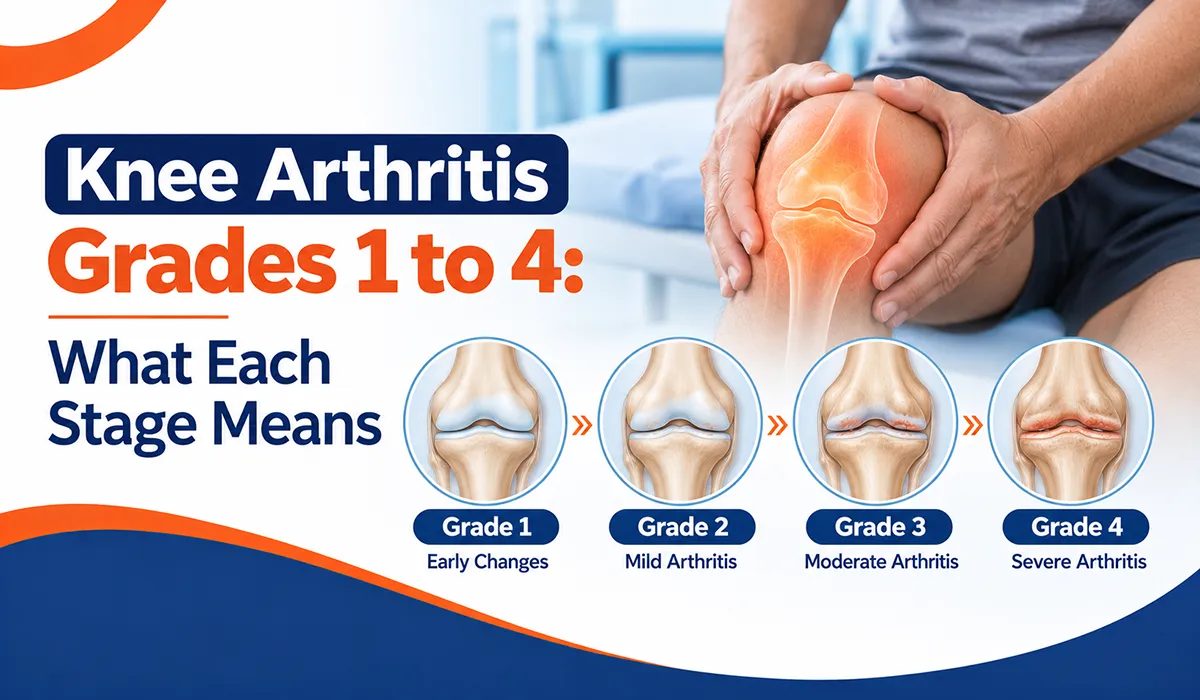
Knee arthritis is graded from 1 to 4 on an X-ray. Grade 1 is very mild and often painless. Grade 2 is mild, with early bone spurs. Grade 3 is moderate, with clear loss of joint space and regular pain. Grade 4 is severe, with bone rubbing on bone, stiffness and often a bent or bow-legged knee. Your treatment depends on your symptoms as much as on your grade.
Many people first hear about grades when they read an X-ray report. A line like “grade 3 osteoarthritis” can sound frightening, and the next worry is usually surgery.
The truth is calmer than that. A grade tells you how the joint looks on an X-ray. It does not tell you how much pain you will have, and it does not decide your treatment by itself. This guide explains what each grade means, what you may feel, and what usually helps at each stage.
If you want a wider view of treatment options first, read our guide on whether knee replacement is the only solution for knee arthritis.
Knee arthritis grades at a glance
| Grade | Stage | What the X-ray shows | What you may feel | Usual first step |
|---|---|---|---|---|
| 1 | Very mild (doubtful) | Normal joint space, maybe a tiny bone spur | Often nothing, or slight stiffness after rest | Weight control, exercise, activity changes |
| 2 | Mild | Clear bone spurs, joint space normal or slightly narrow | Pain after long walks or stairs, short morning stiffness | Physiotherapy, pain relief, weight loss |
| 3 | Moderate | Definite narrowing of joint space, several bone spurs, some hardening of bone | Regular pain, swelling, trouble squatting and climbing stairs | Combined plan, injections, brace, early surgery discussion |
| 4 | Severe | Very little joint space, large bone spurs, changed bone shape | Pain at rest and at night, stiffness, limited walking, bow legs | Often knee replacement if other treatment has failed |
How doctors decide the grade
Most orthopaedic doctors use the Kellgren and Lawrence scale, first described in 1957. It looks at an X-ray and checks for three things: the gap between the thigh bone and shin bone, bony growths called osteophytes (bone spurs), and changes in the shape of the bone ends. Grade 0 means a normal knee. Grades 1 to 4 describe increasing damage.
Two points help you read your own report:
- The X-ray should be taken standing. When you stand, your body weight squeezes the joint, so the true gap between the bones shows up. A lying-down X-ray can make the knee look healthier than it is.
- The grade describes the X-ray, not your pain. An MRI is not needed just to give a grade. It is used when the doctor suspects a ligament tear, meniscus injury or another problem alongside arthritis.
Grade 1: Very early changes
What is happening inside the knee: The cartilage, the smooth cushion on the bone ends, has started to thin. The X-ray may show a tiny bone spur, or it may look almost normal.
What you may notice: Many people feel nothing. Some notice a little stiffness after sitting for a long time, or a vague ache after a long walk.
What helps:
- Keep your weight in a healthy range. When you walk, each extra kilo puts about four kilos of extra load on your knees.
- Strengthen the thigh muscles. Strong muscles take pressure off the joint.
- Choose low-impact exercise such as cycling, swimming and flat-ground walking.
- Avoid long hours of deep squatting or kneeling on hard floors if it makes the knee ache.
Grade 1 is the best time to act. Small changes now can keep the knee comfortable for many years.
Grade 2: Mild arthritis
What is happening inside the knee: Bone spurs are now clearly visible. The joint space may be normal or slightly narrower. The cartilage is thinner and rougher.
What you may notice: Pain after long walks, stairs or standing for a long time. The knee feels stiff for a short while in the morning. You may hear cracking or grinding when you bend. Some people feel the knee “give” a little when they get up from the floor.
What helps:
- Guided physiotherapy and a regular strengthening routine
- Weight loss if you are overweight
- Short courses of pain relief, such as gels or tablets, as advised by your doctor
- A walking stick or knee support on long outings
Most people at this stage do not need surgery. The aim is to protect the joint and slow the wear. If you are unsure whether a procedure you read about is a repair or a replacement, our post on microplasty and whether it repairs or replaces the knee joint explains the difference.
Grade 3: Moderate arthritis
What is happening inside the knee: The joint space is clearly narrower. There are several bone spurs, and the bone under the cartilage may look denser and whiter on the X-ray. Some people also start to show a slight change in leg shape.
What you may notice:
- Pain on most days, not only after activity
- Swelling that comes and goes
- Stiffness after rest that takes longer to settle
- Trouble climbing stairs, getting up from a chair or sitting on the floor
- Shorter walking distance, for example to the market or temple
What helps:
- Everything from Grade 2, done more regularly
- Injections into the knee in selected patients. A steroid injection can calm a flare for a few weeks to months. Other injections, such as hyaluronic acid or platelet-rich plasma (PRP), help some people but not all, and research results are mixed. Your doctor will tell you honestly whether they are worth trying for your knee.
- A knee brace or walking stick on bad days
- A clear talk with your surgeon about what to do if the pain keeps limiting your life
Grade 3 is the stage where many people feel stuck between “too early for surgery” and “too painful to ignore.” The decision depends on how much the knee limits your daily life, not on the grade alone. If you have bow legs, the doctor may also check whether the alignment of your leg is adding to the problem. Some younger patients are advised deformity correction before a replacement is ever needed.
Grade 4: Severe arthritis
What is happening inside the knee: Most of the cartilage is gone. The joint space is very small, and the bone ends rub against each other. Large bone spurs form, and the bone shape changes. The knee may look bent inward or outward.
What you may notice:
- Pain even when resting, and pain that wakes you at night
- A knee that is stiff, swollen and hard to straighten or bend fully
- Bow legs or knock knees that are getting worse
- Short walking distance, or needing support to walk
- Trouble with daily tasks such as dressing, bathing, using an Indian toilet or climbing a few steps
What helps:
Medicine, injections and physiotherapy can still ease symptoms, but they often give less relief at this stage. When pain stops you from walking, sleeping or doing normal work, total knee replacement is often the most reliable way to get you moving again.
In knee replacement, the worn surfaces are replaced with metal and medical-grade plastic parts. Most people stand and walk with a walker the day after surgery and stay in hospital for 2 to 4 days. Modern implants commonly last 15 to 20 years or more. Some patients ask whether robotic knee replacement is a better option, and we explain who it suits during the consultation.
A common worry is sitting on the floor afterwards. Read how one patient regained cross-legged sitting after knee replacement to see what is realistic.
Your grade is not the whole story
Two people can both have Grade 3 on their X-rays and feel very different. One walks 5 km every morning. The other struggles to reach the kitchen. That is why a good doctor never decides treatment from the X-ray alone.
Your doctor will look at:
- How far you can walk before pain stops you
- Whether pain disturbs your sleep
- How much the knee limits your work, prayer, shopping and family life
- Your age, weight, other health problems and the shape of your legs
- What you have already tried, and how much it helped
An X-ray gives the grade. Your daily life gives the decision.
Does knee arthritis move from one grade to the next?
Not always, and rarely fast. For most people, osteoarthritis changes slowly over many years. Some people stay at Grade 2 for a very long time.
The wear tends to move faster when:
- Body weight is high
- There was an old injury to the ligament, meniscus or a fracture near the knee
- The legs are bowed or knocked, so one side of the knee carries more load
- The knee is strained every day by heavy work or long periods of deep squatting
- Muscles around the knee are weak
Lost cartilage does not reliably grow back, so no treatment can promise to reverse arthritis. But symptoms can improve a lot, and the speed of wear can be slowed. That is why starting early matters.
Treatment by grade
| Grade | Main focus | Options your doctor may discuss |
|---|---|---|
| 1 | Protect the joint | Weight control, strengthening, low-impact exercise |
| 2 | Control symptoms, slow wear | Physiotherapy, pain relief, walking aids, weight loss |
| 3 | Keep you active, plan ahead | Combined treatment, selected injections, brace, alignment check, surgery discussion if life is limited |
| 4 | Restore walking and sleep | Knee replacement when other treatment no longer works |
Supplements such as glucosamine and chondroitin are widely used, but research shows only small or uncertain benefit. Ask your doctor before spending money on them.
When is knee replacement the right step?
Grade 4 does not mean you must have surgery tomorrow, and Grade 3 does not always mean you can avoid it. Knee replacement is worth discussing when:
- Pain continues despite medicine, exercise and injections
- You cannot walk comfortably or climb stairs
- Pain disturbs your sleep or comes at rest
- Your knees are becoming more bowed or knocked
- Daily work, travel and family life are affected
Waiting too long has a cost. Pain makes you move less, the thigh muscles weaken, and the joint shape can worsen, which can make recovery harder later. If you want to compare options, our post on what to look for in a knee replacement surgeon in Ahmedabad may help, and you can read how expert knee replacement relieves chronic knee pain.
Patients from Memnagar, Vastrapur, Thaltej, Sola, Bodakdev, Science City and Gandhinagar visit us for knee care. If you live abroad, our NRI patient care team can plan your visit, and you can read about knee replacement for NRIs in Ahmedabad.
Warning signs: see a doctor soon
Arthritis is usually slow. These signs are not, and they need quick attention:
- A knee that suddenly becomes hot, red and very swollen, especially with fever
- Inability to put weight on the leg after a fall or twist
- The knee locking so you cannot straighten it
- Swelling and pain in the calf
For injuries or sudden severe pain, call us on +91 7600 764 211. OrthoD Hospital provides 24×7 emergency care for orthopaedic problems.
Not every knee problem is arthritis. A twisting injury with a pop and a feeling of the knee giving way may be a ligament tear. Read about ACL tears, their symptoms and treatment.
How we check your knee at OrthoD Hospital
At OrthoD Hospital in Memnagar, your visit with Dr. Ruchir Patel follows a simple plan:
- Your story. You describe your pain, walking distance, sleep and daily needs.
- Examination. The doctor checks movement, swelling, leg shape and muscle strength.
- Tests. If needed, a standing X-ray is arranged. Other tests are added only when they will change the plan.
- Clear explanation. You are told your grade in simple words, with all your options.
- Your decision. For surgery, you are told the expected cost and recovery time before you decide.
Dr. Patel completed his orthopaedic training at Civil Hospital, Ahmedabad and trained in South Korea. Read more about his background and experience. We accept all types of health insurance, cashless or reimbursement.
Frequently asked questions
Can knee arthritis be reversed?
No treatment is proven to regrow lost cartilage reliably. But the symptoms can improve a great deal, and the wear can be slowed. Weight loss, strong thigh muscles and the right activity can keep an early-grade knee comfortable for many years.
Is Grade 3 knee arthritis serious?
Grade 3 is moderate. It is real arthritis that deserves proper treatment, but it is not an emergency. Many people manage Grade 3 with physiotherapy, weight control and selected injections. Surgery becomes a topic when pain keeps limiting daily life.
Do I need surgery for Grade 3 or Grade 4?
Not automatically. The decision is based on your pain, sleep, walking and daily function, along with your X-ray. Grade 4 with severe pain usually leads to knee replacement. Grade 3 may be managed without surgery for a long time.
How long does it take to go from Grade 1 to Grade 4?
There is no fixed time. For many people it takes years, and some people never reach Grade 4. Body weight, old injuries, leg alignment and activity all change the speed.
Can someone have Grade 4 arthritis and little pain?
It can happen, but it is uncommon. Most people with Grade 4 have clear pain and stiffness. If your X-ray looks worse than you feel, your doctor may simply watch the knee and keep you on exercise and weight control.
Which exercises are good for knee arthritis?
Thigh-strengthening exercises, cycling, swimming and flat-ground walking are usually well tolerated. Deep squats, running and jumping can aggravate a painful knee. A physiotherapist can tailor the plan to your grade.
Can I still sit on the floor with knee arthritis?
In early grades, many people can. As arthritis advances, deep bending becomes painful. After knee replacement, many patients can sit cross-legged again, though deep bending can stay limited. Discuss your daily needs with the doctor before choosing treatment.
Which doctor should I see for knee arthritis?
An orthopaedic doctor, ideally one who treats knee problems and joint replacement. They can read your X-ray, examine your knee and explain your options in plain language.
Book a knee consultation in Memnagar, Ahmedabad
If knee pain is limiting your walking, sleep or work, get it checked. An early visit gives you more options. A late visit does not close the door, but it can narrow it.
- Call: +91 7600 764 211
- Book online: Book an appointment
- OPD hours: Monday to Saturday, 10 AM to 1 PM and 5 PM to 8 PM
- Address: 209-211, Nobles Trade Centre, Satadhar Cross Roads, opposite BD Rao Hall, near Bhuyangdev Cross Road, Memnagar, Ahmedabad 380052
Can’t visit in person? Send your X-ray and reports to Dr. Patel on WhatsApp for an online consultation. See the contact page for details.