
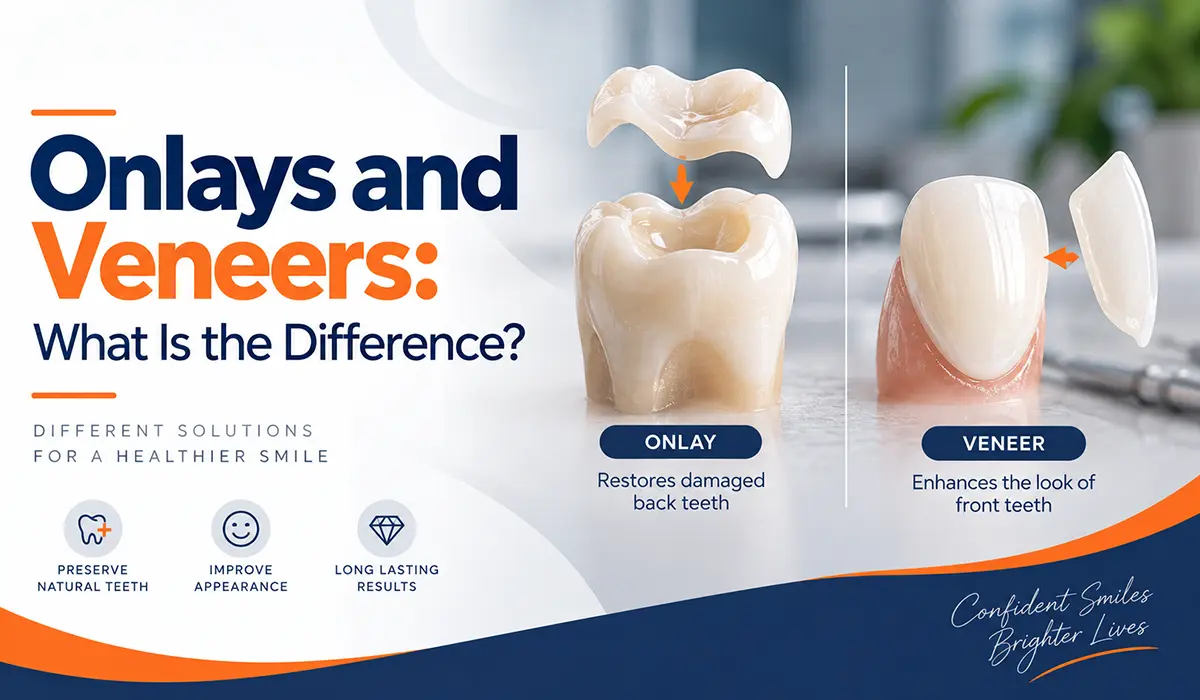
The main difference is simple. An onlay repairs a tooth that has decay or damage, usually a back tooth. A veneer improves the way a front tooth looks. One brings a tooth back to full function, the other improves appearance. Many people mix up the two because both are tooth coloured and both are custom made, but they solve very different problems.
Here is a full look at each option, how they compare, and how to know which one fits your situation.
What is a dental onlay?
An onlay is a custom made restoration that covers part of the chewing surface of a tooth, including one or more of the raised points called cusps. Dentists use it when a tooth has too much decay or damage for a normal filling, but not enough to need a full crown. It is bonded directly onto the tooth.
Onlays are usually placed on back teeth, the molars and premolars, because these teeth handle most of your chewing. The material is often porcelain or a tooth coloured composite, so the repair blends in and is hard to notice.
Because an onlay only replaces the damaged part, your dentist can keep more of your healthy tooth compared with a full crown. That is one of the main reasons people choose it.
You might need an onlay if you have:
- A large cavity that a filling cannot hold well
- A cracked or worn back tooth
- An old filling that has broken down and needs replacing
- A weak tooth that still has healthy structure worth saving
What is a dental veneer?
A veneer is a thin shell, usually porcelain or composite, bonded to the front of a tooth. Its job is cosmetic. It changes how a tooth looks without changing how you chew.
Dentists place veneers on the teeth that show when you smile, mostly the upper and lower front teeth. A veneer can cover stains that whitening cannot fix, reshape a tooth, close small gaps, or hide chips and minor flaws.
Porcelain veneers are known for looking natural because they reflect light in a way that is close to real enamel. Composite veneers cost less and can often be done in a single visit, but they usually do not last as long.
You might consider veneers if you want to improve:
- Deep stains or discolouration
- Small chips or worn edges
- Minor gaps between front teeth
- Teeth that are slightly uneven in shape or size
The main differences between onlays and veneers
| Onlay | Veneer | |
|---|---|---|
| Main purpose | Repair damage or decay | Improve appearance |
| Where it is used | Back teeth (chewing surface) | Front teeth (visible surface) |
| What it covers | Part of the top of the tooth, including cusps | The front face of the tooth |
| Type of treatment | Restorative | Cosmetic |
| Common materials | Porcelain, composite, sometimes gold | Porcelain, composite |
| Main benefit | Restores strength and chewing | Creates a more even, brighter smile |
The simplest way to remember it: an onlay brings a damaged tooth back to health, and a veneer makes a healthy tooth look better.
Which one is right for you?
The right choice depends on what your tooth needs, not on which treatment sounds nicer. If a back tooth is decayed or cracked and you want to chew comfortably again, an onlay is likely the answer. If your front teeth are healthy but you are unhappy with their colour or shape, veneers may suit you.
Some people need both, for different teeth and different reasons. A back molar might need an onlay to stay strong, while the front teeth get veneers for a more even smile. A proper dental exam is the only way to be sure. Your dentist will check the health of each tooth, take X-rays if needed, and talk through what will work for your situation and budget.
What to expect during treatment
Both treatments usually take two visits, though some clinics offer same day options using digital scanning and in house milling.
For an onlay, the dentist removes the decay or damaged part, takes an impression or digital scan, and fits the finished onlay at a later visit. It is then bonded firmly onto the tooth.
For a veneer, the dentist may remove a very thin layer of enamel so the veneer sits flush, takes a scan or impression, and bonds the shell to the front of the tooth once it is ready. Some minimal prep veneers need little or no enamel removal.
Both are done with local anaesthetic when needed, so the process stays comfortable.
How long do onlays and veneers last?
With good care, porcelain onlays often last 10 to 15 years or more. Porcelain veneers usually last around 10 to 15 years, while composite veneers may need replacing sooner, often within 5 to 7 years.
To help them last:
- Brush twice a day and floss daily
- Avoid biting hard objects like ice or pen caps
- Wear a night guard if you grind your teeth
- Keep up with regular dental checkups
What about the cost?
The cost of onlays and veneers depends on the material used, how many teeth are treated, and how complex the case is. Porcelain generally costs more than composite. The most accurate way to know your cost is a consultation, where the dentist can look at your teeth and give you a clear treatment plan and quote.
Frequently asked questions
Are onlays and veneers the same thing?
No. An onlay repairs a damaged or decayed tooth, usually at the back. A veneer improves the look of a front tooth. They serve different purposes.
Do onlays and veneers look natural?
Yes. Both are colour matched to your teeth. Porcelain in particular reflects light like natural enamel, so the results blend in well.
Is the procedure painful?
No. Local anaesthetic is used when needed, so you should not feel pain during treatment. Some mild sensitivity afterwards is normal and settles quickly.
Can I get veneers on my back teeth?
Veneers are made for the front, visible teeth. Back teeth that do heavy chewing are usually better restored with an onlay or crown, which are built to handle stronger forces.
How do I know which one I need?
A dental exam is the only reliable way. Your dentist will assess each tooth and recommend the option that protects your dental health and gives you the look you want.
Talk to a dentist in Memnagar, Ahmedabad
Choosing between an onlay and a veneer is easier with expert guidance. Dr. Urvi Patel at Ortho D Hospital in Memnagar, Ahmedabad can examine your teeth, explain your options in plain language, and plan treatment that fits your needs and budget.
Book a consultation at Ortho D Hospital to find out which option is right for your smile.